



The millennial mindset
Who we are
Courtesy of U.S. Trust.
How we collect
Courtesy of U.S. Trust
Making a difference?
Courtesy of U.S. Trust.
Technology and transparency
Courtesy of U.S. Trust.
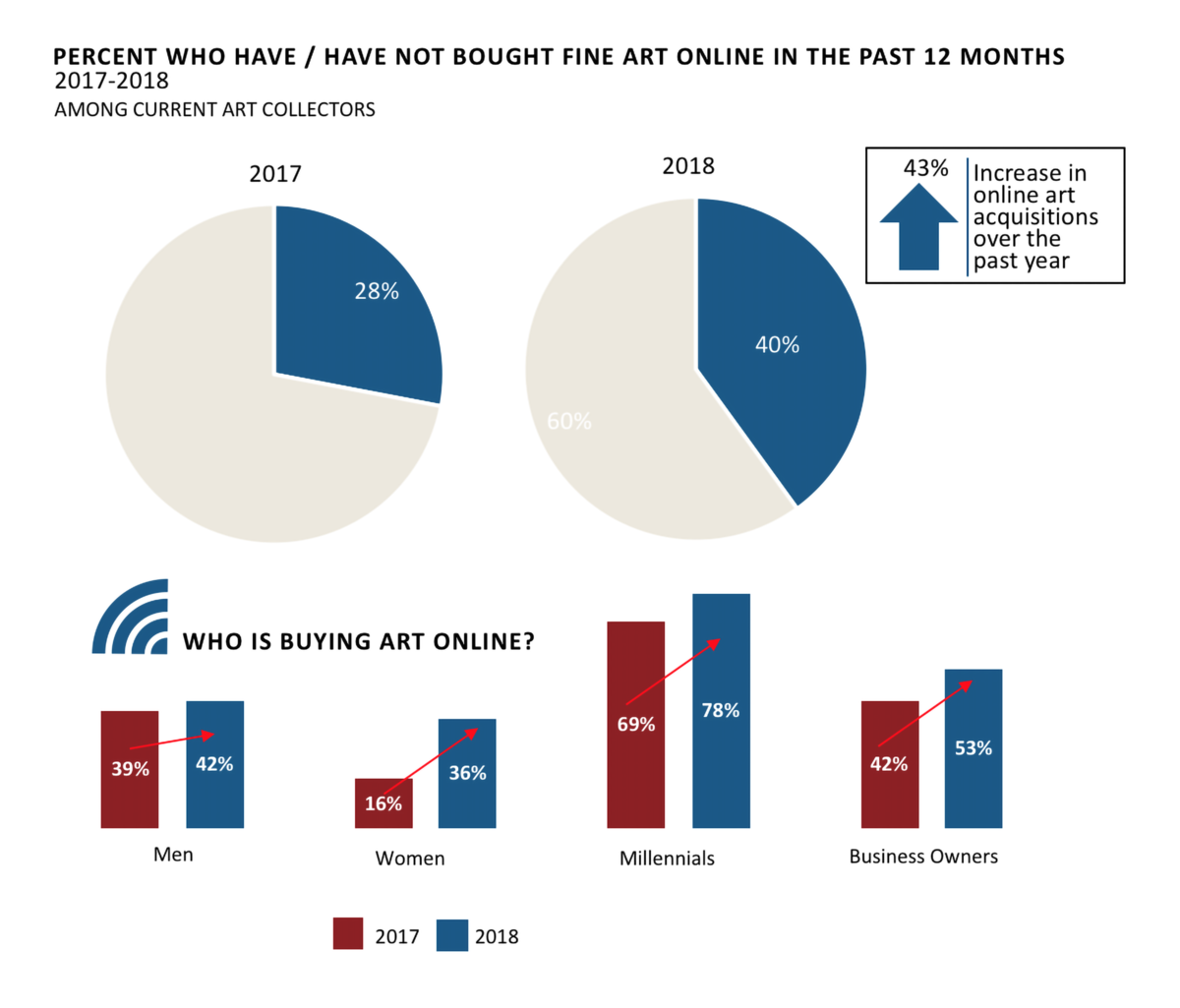
We’ll use technology to co-opt art to enhance our personal brands—not so much in our real lives, but in our digital avatar lives on social media. Trent says that Instagram “has been the real game-changer for the art world.” It’s the perfect mix of visual and social. She notes that “for the first time, a completely open awareness exists about who owns and who collects what.” This hyper-connected transparency may benefit the market, but it might also imbue our collecting with a herd mentality, defined by insta-trends, branding, and channel buzz (try and find a hedge fund manager today not looking to acquire a George Condo).
Age of identity
There is one mega-trend that my generation may end. If 19th-century art was about beauty and the 20th about concepts, the 21st century has been about identity. Earlier this year, I attended an acquisitions committee meeting at a West Coast museum. Each curator had five minutes to make a Shark Tank-style pitch to trustees on why endowment funds should be spent on their chosen work. As the session wore on, I was struck by how little was said about the actual art. Every pitch focused on the artist’s biography: race, sexual identity, feminist credentials, overcoming hardships; nothing on composition, form, or historical context. To be sure, this approach is part of a broader (and overdue) reexamination of minority and female artists by boomer curators and collectors. But I think the moment is short-lived. Our M.O. is inclusion—leaning in, wokeness, the ever-expanding LGBTQIAPK spectrum. We think Kerry James Marshall is a damn good artist, not a damn good black artist. And as we become a dominant collecting force, identity will become less of a novelty, and art will again be judged on its own aesthetic merit.
What this means for the art market
This content represents thoughts of the author and does not necessarily represent the position of Bank of America or U.S. Trust. U.S. Trust operates through Bank of America, N.A. and other subsidiaries of Bank of America Corporation. Bank of America, N.A., Member FDIC. © 2018 Bank of America Corporation. All rights reserved.
(via www.artsy.net)